
Sailors love checklists
When we first talked about our Boat Check many of you asked for more details. Well – you asked, and we responded.
“Boat check” is something that the off-going watch does before they are relieved of their duties. It takes about 15-20 min to do a thorough job. Our watch schedule on our sail training expeditions is usually 6 hours on, 6 hours off, but we rotate a person every 3 hours. Therefore, Boat Check happens every 3 hours.
Things can happen quickly on a boat, but many things happen slowly. It is those slow problems like chafe, wear, torque, silent drips, etc. that will lead to large problems. Checking everything every 3 hours will allow you to notice problems early, monitor their progress, and fix them before they become major issues.
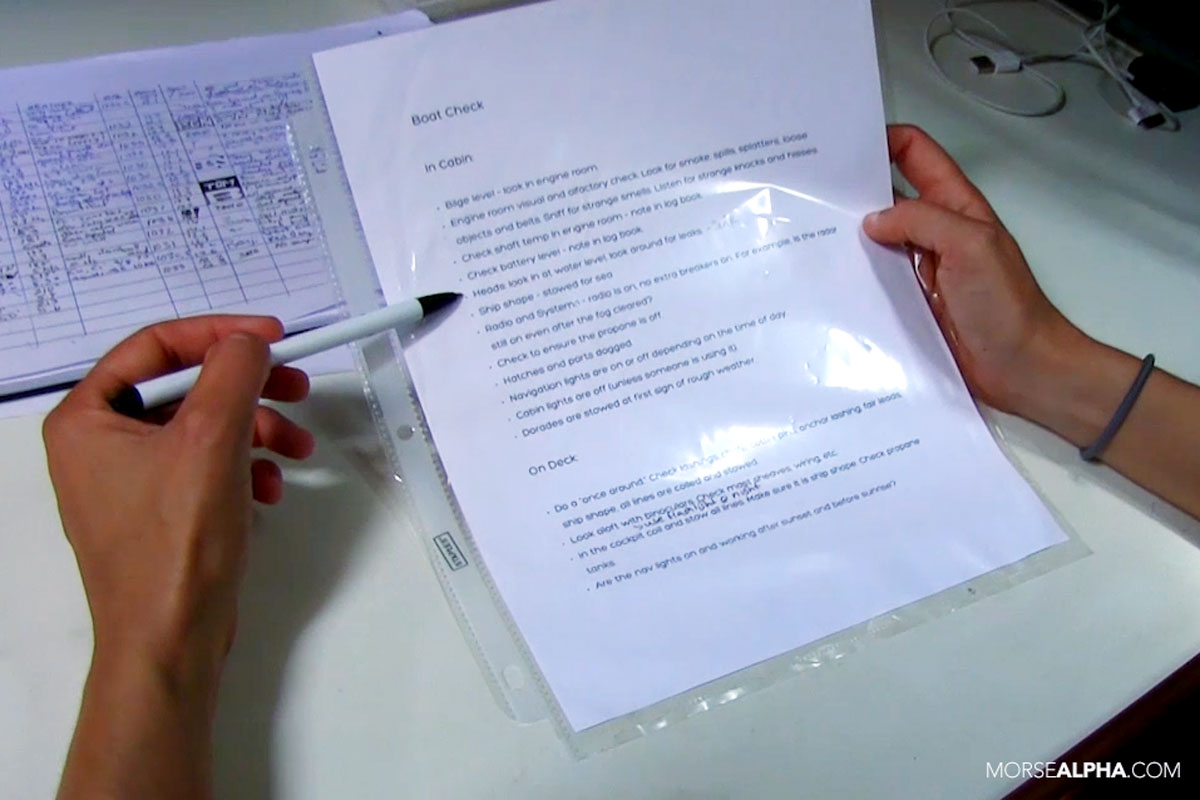
So – you can watch our boat check at this link. Please become a Patreon if you enjoy our videos. They take a lot of time and work to make and we would love to be able to do more for the community.
This Boat Check is a working document – so please do add suggestions in the comments below. We would love to hear your ideas!
Boat Check for Offshore Passages:
In Cabin:
- Bilge level – look in engine room. Has the level changed?
- Engine room visual and olfactory check. Look for smoke, spills, splatters, loose objects and belts. Sniff for strange smells. Listen for strange knocks and hisses.
- Check shaft temp in engine room – note in log book.
- Check battery level – note in log book.
- Heads: look in at water level, look around for leaks. Make sure they are clean for the next watch.
- Ship shape – stowed for sea. Remember to check the galley and wash and show dishes!
- Radio and Systems – radio is on, no extra breakers on. For example, is the radar still on even after the fog cleared?
- Check to ensure the propane is off.
- Hatches and ports dogged.
- Navigation lights are on or off depending on the time of day.
- Cabin lights are off (unless someone is using it).
- Dorade vents are stowed at first sign of rough weather.
- General appearance – do you notice any new drips, possible leaks?
On Deck:
- Do a “once around.” Check lashings, chafe, cotter pins, anchor lashing, fair leads, ship shape, all lines are coiled and stowed.
- Look aloft with binoculars. Check mast sheaves, wiring, etc. At night, shine the spotlight at the top of the mast
- In the cockpit coil and stow all lines. Make sure it is ship shape. Check propane tanks.
- Are the correct navigation lights on and working after sunset and before sunrise?
Log Entry:
- Enter all the necessary data in the log including: position, course and speed, barometric pressure, battery level, sail plan changes, weather (wind direction, speed, cloud cover, precip, etc).
- Add any additional notes in the log. Please include fun stuff as well! What happened on watch – dolphins, cookies, seasickness, etc!
- Don’t forget to plot a position on the chart using correct notation for an electronic fix, celestial fix, DR, or triangulation.
- Review the logbook, weather, sail plan, watch details and anything else of consequence with the oncoming watch.
Engine Check:
To be done before running the engine.
- Oil
- Coolant (check only when cool)
- Belt tension
- Look for drips
- Bilge level
- Raw water filter (sea water)
- Racor (fuel filter)
- Transmission fluid

Watch our youtube video about boat checks!